
Speaking Lab
Image-based speaking practice with useful phrases, pronunciation focus and model response.
Lesson objectives
- Describe, compare and speculate more naturally under speaking-task pressure.
- Use useful phrases with better rhythm, stress and connected speech.
- Respond to image prompts connected to media, communication & influence with C1-level range.
Listen to the model audio before you answer the lesson tasks.
Speaking — describe & compare
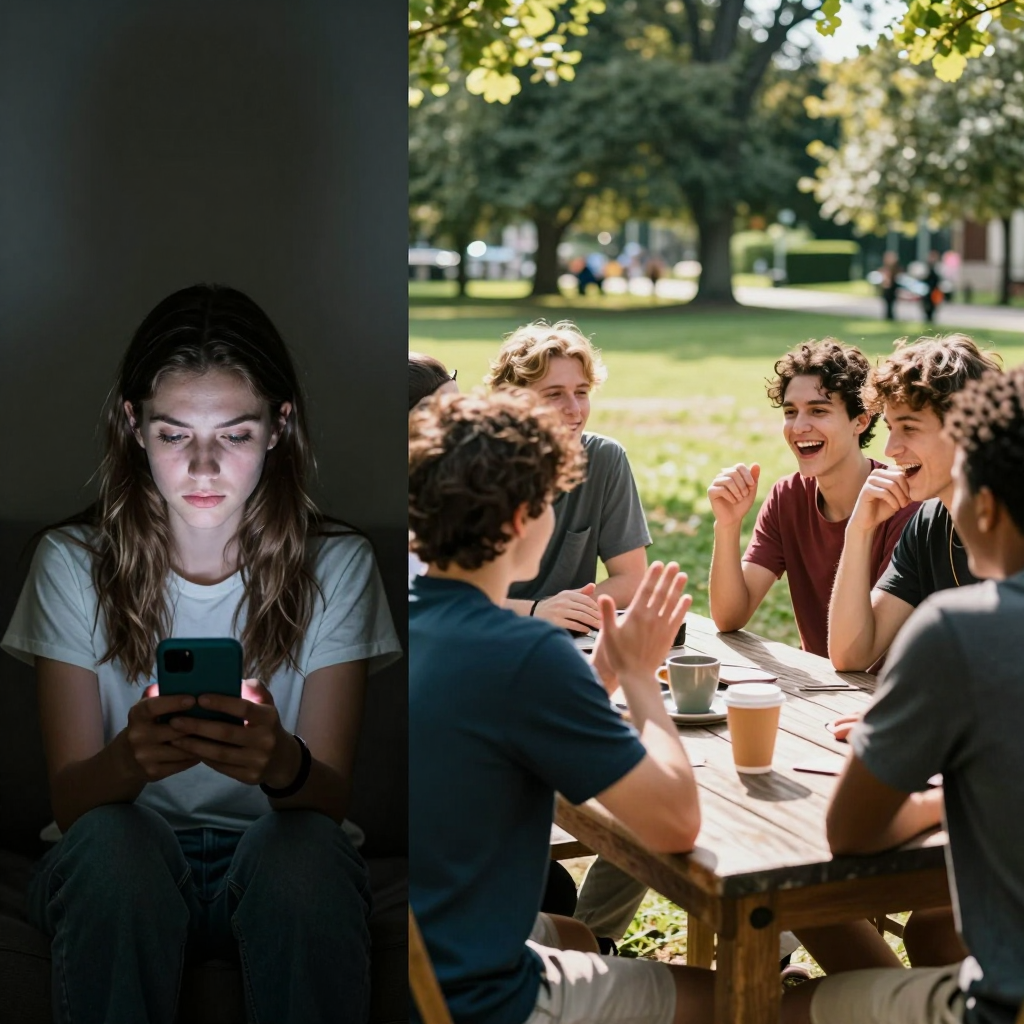
Compara estas dos imágenes. En tu respuesta, debes describir las diferencias en los métodos de comunicación y la naturaleza de la interacción social. Debes también responder a la pregunta: ¿Qué impacto crees que tiene el uso de la tecnología en la calidad de nuestras relaciones personales? Habla durante aproximadamente dos minutos.
🖼️ 
Useful phrases
- In the first image, it appears as though... — En la primera imagen, parece como si... 🔊
- The two scenes stand in stark contrast to one another. — Las dos escenas contrastan fuertemente entre sí. 🔊
- While the first depicts isolation, the second suggests... — Mientras que la primera representa el aislamiento, la segunda sugiere... 🔊
- One could argue that the digital medium leads to... — Se podría argumentar que el medio digital conduce a... 🔊
- There is a palpable sense of... — Hay una sensación palpable de... 🔊
- In much the same way, the second photo illustrates... — De la misma manera, la segunda foto ilustra... 🔊
- It is highly likely that the subject is feeling... — Es muy probable que el sujeto se sienta... 🔊
- Conversely, the second scene conveys a sense of... — Por el contrario, la segunda escena transmite una sensación de... 🔊
- The visual cues suggest that... — Las pistas visuales sugieren que... 🔊
- This stands in direct opposition to... — Esto se opone directamente a... 🔊
- It is arguably the case that... — Podría decirse que... 🔊
- The contrast between the two is quite striking. — El contraste entre las dos es bastante llamativo. 🔊
Pronunciación
Para alcanzar un nivel C1, utiliza la entonación para transmitir matices. Cuando compares situaciones opuestas, usa una entonación descendente para enfatizar la finalidad de una idea y una entonación ascendente para crear suspense o mostrar duda al especular. Evita un tono monótono; la entonación debe reflejar tu actitud (por ejemplo, usa un tono más suave para hablar de aislamiento y uno más dinámico para la interacción social).
Model answer
🔊
The two images present a striking contrast regarding how we communicate and connect with others. In the first photograph, we see a young woman completely absorbed in her smartphone. The dim lighting and her singular focus suggest a sense of digital isolation, where the screen acts as a barrier to the outside world. It appears as though she is physically present but mentally elsewhere.
In stark contrast, the second image depicts a group of friends enjoying a vibrant, face-to-face interaction in a sunny outdoor setting. Unlike the first scene, there is a palpable sense of warmth and genuine connection. While the first woman is consumed by a digital interface, the group in the second photo is fully engaged in the present moment through verbal and non-verbal cues.
Regarding the impact of technology, I would argue that while digital tools allow us to stay connected globally, they can simultaneously erode the depth of our personal relationships. If we constantly prioritise screens over real-life engagement, as seen in the first image, we risk losing the emotional nuance that only physical presence provides. Ultimately, technology should supplement our social lives, not replace the meaningful connections shown in the second scene.