
Speaking Lab
Image-based speaking practice with useful phrases, pronunciation focus and model response.
Lesson objectives
- Describe, compare and speculate more naturally under speaking-task pressure.
- Use useful phrases with better rhythm, stress and connected speech.
- Respond to image prompts connected to the ethics of scientific research with C1-level range.
Listen to the model audio before you answer the lesson tasks.
Speaking — describe & compare
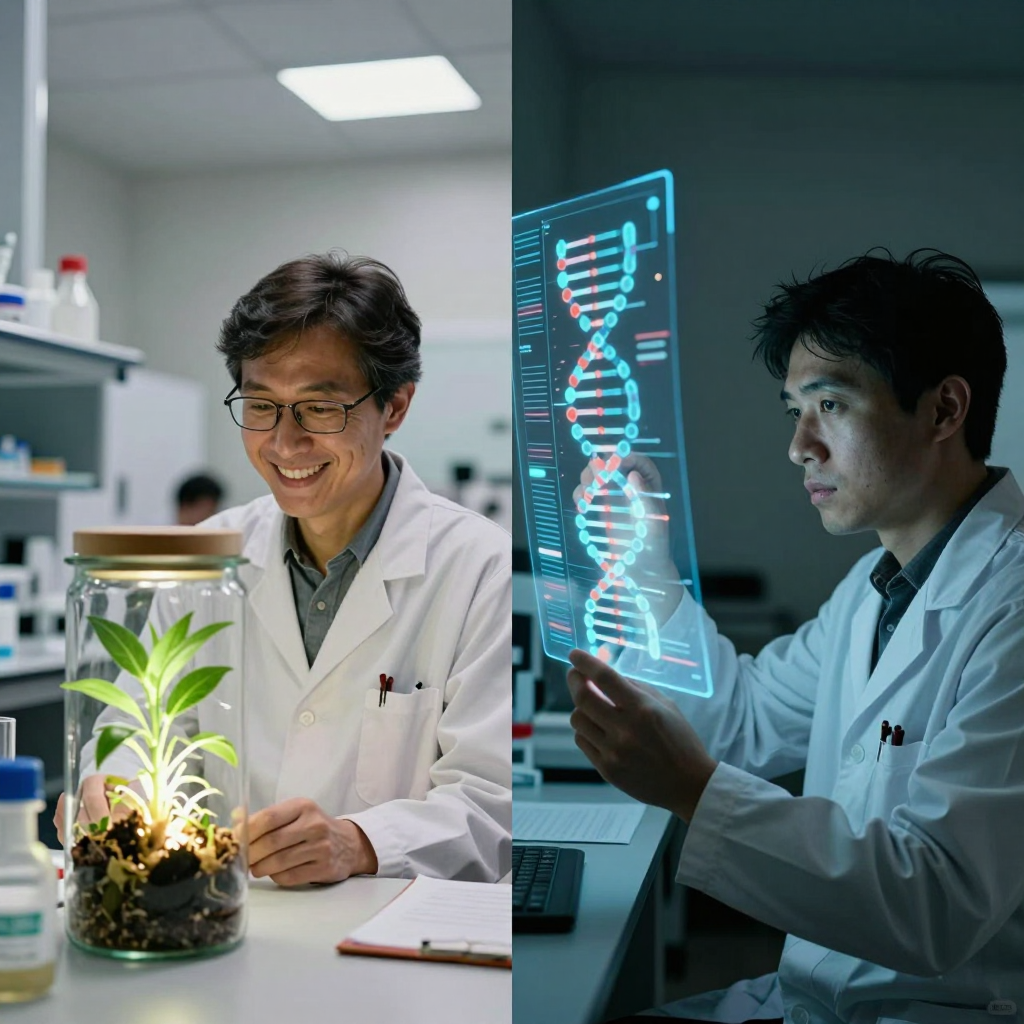
Compara estas dos imágenes y responde a las preguntas. En la primera imagen, describe la atmósfera y la relación del científico con su trabajo. En la segunda, analiza las implicaciones éticas que sugiere la escena. Debes hablar durante 2 minutos, comparando los enfoques de la investigación científica en ambos escenarios.
🖼️ 
Useful phrases
- It appears to me that the researcher is... — Me parece que el investigador está... 🔊
- One could argue that this represents... — Se podría argumentar que esto representa... 🔊
- In stark contrast to the first image... — En marcado contraste con la primera imagen... 🔊
- There is a palpable sense of... — Hay una sensación palpable de... 🔊
- The lighting suggests a shift towards... — La iluminación sugiere un cambio hacia... 🔊
- It is highly likely that the focus is on... — Es muy probable que el enfoque esté en... 🔊
- While the first scene depicts..., the second portrays... — Mientras que la primera escena representa..., la segunda retrata... 🔊
- This might be interpreted as a metaphor for... — Esto podría interpretarse como una metáfora de... 🔊
- The ambiguity of the situation implies... — La ambigüedad de la situación implica... 🔊
- Both images touch upon the theme of... — Ambas imágenes tocan el tema de... 🔊
- It is debatable whether this research is... — Es debatible si esta investigación es... 🔊
- The visual cues point towards a tension between... — Las pistas visuales apuntan hacia una tensión entre... 🔊
Pronunciación
En inglés, las vocales en sílabas no acentuadas suelen reducirse al sonido 'schwa' /ə/. Por ejemplo, en la palabra 'researcher', la segunda 'e' no suena como una 'e' clara, sino como un sonido neutro y breve. Practica relajar la mandíbula en las sílabas débiles para lograr un ritmo natural de nivel C1.
Model answer
🔊
Both images depict scientists engaged in research, yet they convey vastly different ethical undertones. In the first image, the atmosphere is quite optimistic; the bright lighting and the scientist's smile suggest a harmonious relationship between human innovation and nature. It appears to me that this represents the 'ideal' side of science—discovery that aims to enhance life. In stark contrast to this, the second image feels much more clinical and perhaps even unsettling. The heavy shadows and the intense focus on the holographic DNA suggest a more detached, purely analytical approach. One could argue that this represents the potential dangers of genetic manipulation or the loss of human connection in the pursuit of data. While the first scene depicts a sense of wonder, the second portrays a more sterile, high-stakes environment where the ethical boundaries might be blurred. Ultimately, both images touch upon the tension between scientific progress and its moral implications. The first suggests a natural integration, whereas the second highlights the cold, complex reality of modern biotechnology. It is highly likely that the viewer is meant to reflect on whether science serves life or merely seeks to control it.