
Speaking Lab
Image-based speaking practice with useful phrases, pronunciation focus and model response.
Lesson objectives
- Describe, compare and speculate more naturally under speaking-task pressure.
- Use useful phrases with better rhythm, stress and connected speech.
- Respond to image prompts connected to ocean health & marine conservation with C1-level range.
Listen to the model audio before you answer the lesson tasks.
Speaking — describe & compare
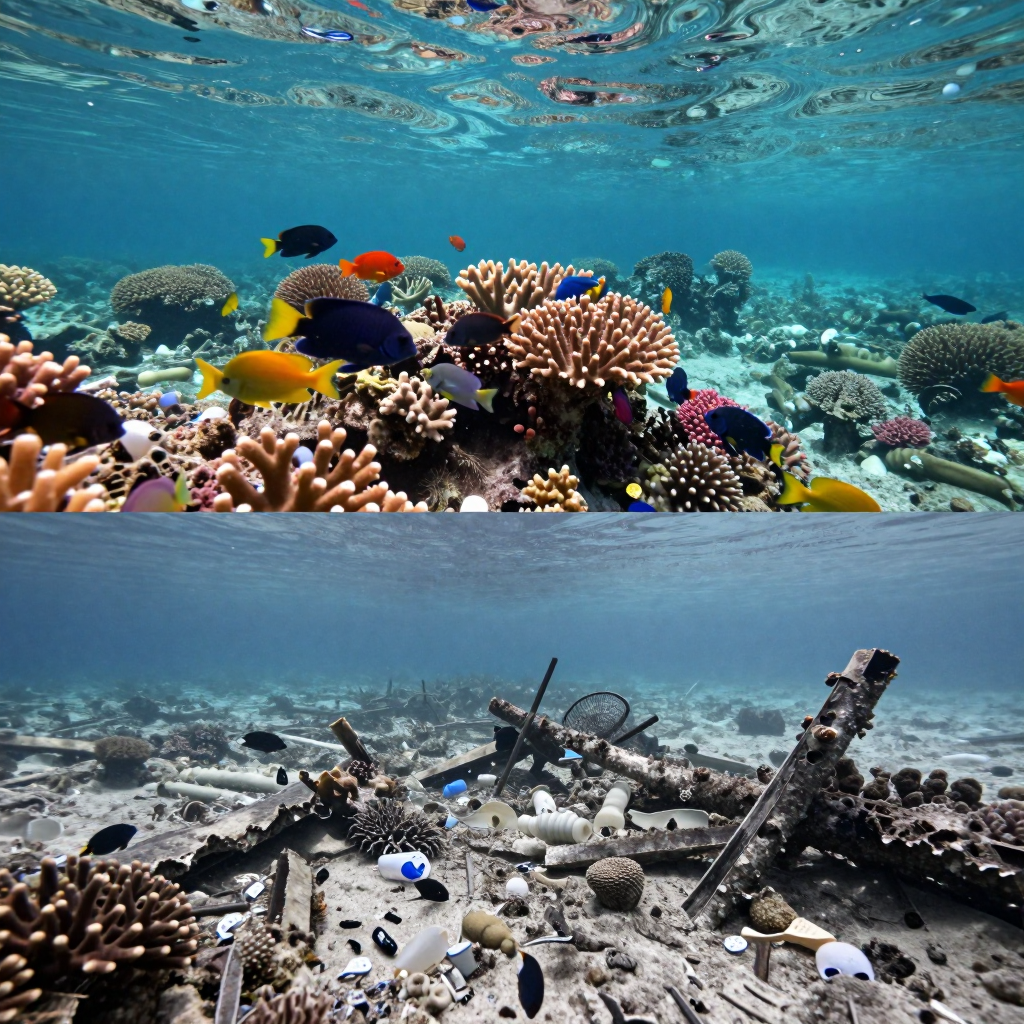
Compara estas dos imágenes. En tu respuesta, debes describir las diferencias entre los dos entornos marinos, comparar la salud de los ecosistemas y especular sobre las causas de estos cambios. Habla durante 2 minutos.
🖼️ 
Useful phrases
- The two images stand in stark contrast to one another. — Las dos imágenes contrastan fuertemente entre sí. 🔊
- While the first scene depicts a thriving ecosystem, the second suggests... — Mientras que la primera escena representa un ecosistema próspero, la segunda sugiere... 🔊
- It is highly probable that the degradation is due to... — Es muy probable que la degradación se deba a... 🔊
- One could argue that the disparity between the two is quite alarming. — Se podría argumentar que la disparidad entre las dos es bastante alarmante. 🔊
- The visual evidence points towards a significant decline in... — La evidencia visual apunta hacia un descenso significativo en... 🔊
- In much the same way as the first image, the second shows... — De la misma manera que la primera imagen, la segunda muestra... 🔊
- It might be inferred that human intervention has played a role. — Se podría inferir que la intervención humana ha desempeñado un papel. 🔊
- There is a noticeable difference in the level of biodiversity. — Hay una diferencia notable en el nivel de biodiversidad. 🔊
- The murky water in the bottom image gives the impression of... — El agua turbia en la imagen inferior da la impresión de... 🔊
- Judging by the appearance of the coral, it seems that... — A juzgar por la apariencia del coral, parece que... 🔊
- The juxtaposition of these two scenes highlights... — La yuxtaposición de estas dos escenas resalta... 🔊
- Conversely, the lower half of the image depicts a much bleaker reality. — Por el contrario, la mitad inferior de la imagen representa una realidad mucho más sombría. 🔊
Pronunciación
Para alcanzar un nivel C1, debes dominar los diptongos para evitar que tu habla suene monótona. Practica la transición suave entre vocales. Por ejemplo, en /eɪ/ (say), /aɪ/ (sky), /ɔɪ/ (boy), /əʊ/ (go), y /aʊ/ (now). Un error común es pronunciar estas como vocales simples; asegúrate de que el movimiento de la lengua sea claro para que el sonido sea dinámico y natural.
Model answer
🔊
The two images stand in stark contrast to one another, presenting a visual narrative of environmental change. In the top half, we see a vibrant, healthy coral reef. The water is crystal clear, and the abundance of colourful marine life suggests a thriving, balanced ecosystem. The sunlight filtering through the surface adds to this sense of vitality.
Conversely, the bottom half depicts a much bleaker reality. The coral appears bleached and lifeless, resulting in a grey, desolate landscape. There is a noticeable amount of plastic debris scattered across the seabed, which suggests significant human impact. While the first scene is full of life, the second depicts a dying habitat.
It is highly probable that the disparity between these two scenes is caused by rising ocean temperatures and pollution. One could argue that the bleaching seen in the lower image is a direct consequence of climate change. Judging by the visual evidence, the transition from the top scene to the bottom one represents a catastrophic loss of biodiversity. Ultimately, the juxtaposition of these two scenes highlights the fragility of our oceans and the urgent need for conservation efforts to prevent such degradation from becoming the global norm.