
Speaking Lab
Image-based speaking practice with useful phrases, pronunciation focus and model response.
Lesson objectives
- Describe, compare and speculate more naturally under speaking-task pressure.
- Use useful phrases with better rhythm, stress and connected speech.
- Respond to image prompts connected to intellectual property, patents & ai with C1-level range.
Listen to the model audio before you answer the lesson tasks.
Speaking — describe & compare
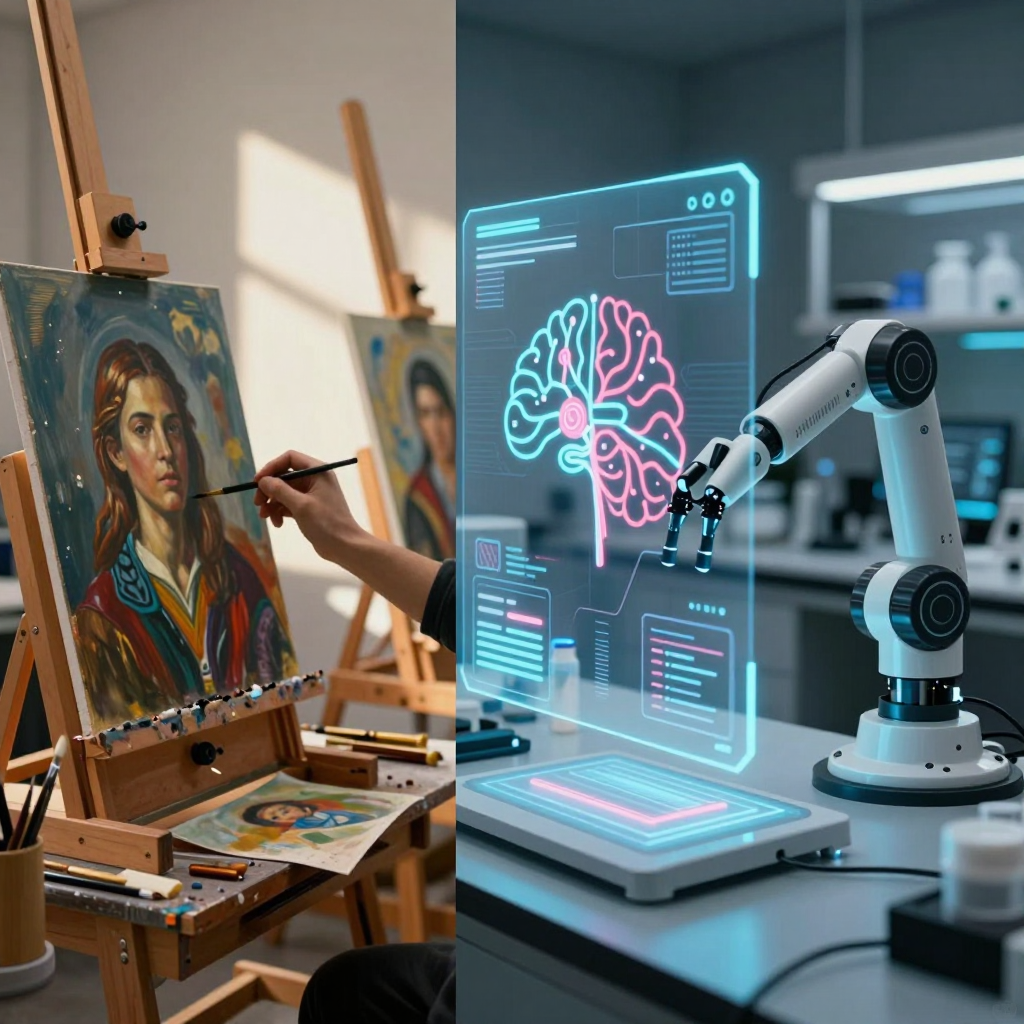
Comparar las dos imágenes. Describa las diferencias y similitudes, y responda a la pregunta: ¿Qué implicaciones tienen estas escenas para la propiedad intelectual y el futuro de la creatividad humana? Debe hablar durante 1 minuto y luego responder a una pregunta adicional durante 1 minuto.
🖼️ 
Useful phrases
- On the one hand, the left image depicts... — Por un lado, la imagen de la izquierda representa... 🔊
- In stark contrast to the traditional setting... — En marcado contraste con el entorno tradicional... 🔊
- The two scenes appear to juxtapose... — Las dos escenas parecen yuxtaponer... 🔊
- It is highly probable that this represents... — Es muy probable que esto represente... 🔊
- One could argue that the distinction lies in... — Se podría argumentar que la distinción reside en... 🔊
- The visual elements suggest a shift towards... — Los elementos visuales sugieren un cambio hacia... 🔊
- While the first scene evokes a sense of... — Mientras que la primera escena evoca una sensación de... 🔊
- There is a noticeable discrepancy between... — Hay una discrepancia notable entre... 🔊
- It might be inferred that... — Se podría inferir que... 🔊
- The juxtaposition highlights the tension between... — La yuxtaposición resalta la tensión entre... 🔊
- This could potentially lead to questions regarding... — Esto podría conducir potencialmente a preguntas sobre... 🔊
- Strikingly, the transition from left to right implies... — Sorprendentemente, la transición de izquierda a derecha implica... 🔊
Pronunciación
Para mejorar tu fluidez en la Parte 2, utiliza el 'pitch range' (rango de entonación) para marcar contrastes. Cuando compares dos ideas opuestas, eleva ligeramente el tono al presentar la primera y baja el tono para enfatizar el contraste con la segunda. Evita un tono monótono; usa el énfasis (stress) en palabras clave como 'starkly', 'completely' o 'fundamental' para guiar al examinador a través de tu argumento.
Model answer
🔊
The two images present a striking juxtaposition between traditional craftsmanship and the cutting-edge realm of artificial intelligence. On the left, we see a classic artist's studio, filled with tactile tools like brushes and oil paints, which evokes a sense of human touch and individual expression. In stark contrast, the right side depicts a high-tech laboratory where digital art is being generated through neural networks and robotic precision. While the first scene represents the historical foundation of creativity, the second suggests a future where algorithms take the lead.
This transition raises profound questions regarding intellectual property. If an AI generates a masterpiece, as seen in the right-hand image, the concept of authorship becomes blurred. One might argue that the patent or copyright should belong to the programmer, yet the traditional view suggests it belongs to the creator. This tension between human intuition and algorithmic output is clearly the central theme here. Ultimately, these scenes illustrate the shift from tangible, hand-made art to intangible, data-driven creation, forcing us to redefine what it actually means to 'own' an idea in the digital age.