
Speaking Lab
Image-based speaking practice with useful phrases, pronunciation focus and model response.
Lesson objectives
- Describe, compare and speculate more naturally under speaking-task pressure.
- Use useful phrases with better rhythm, stress and connected speech.
- Respond to image prompts connected to international humanitarian law & conflicts with C1-level range.
Listen to the model audio before you answer the lesson tasks.
Speaking — describe & compare
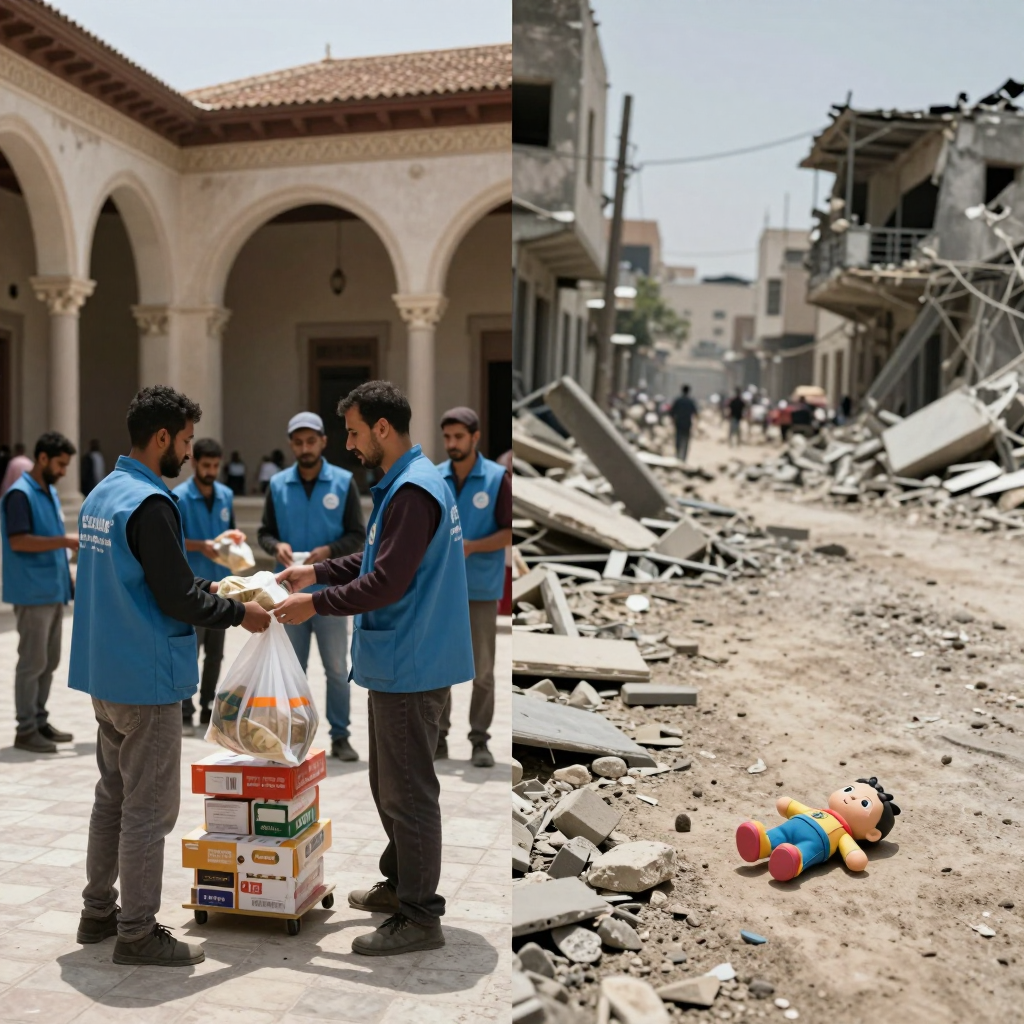
Compara estas dos imágenes. En ambas imágenes vemos las consecuencias de situaciones políticas distintas. Describe las diferencias entre la asistencia humanitaria y las secuelas de un conflicto, y especula sobre cómo estas situaciones afectan a la población civil. Debes hablar durante aproximadamente 2 minutos.
🖼️ 
Useful phrases
- At first glance, it appears that... — A primera vista, parece que... 🔊
- The two scenes stand in stark contrast to one another. — Las dos escenas contrastan fuertemente entre sí. 🔊
- While the left image depicts..., the right one conveys... — Mientras que la imagen de la izquierda representa..., la de la derecha transmite... 🔊
- One could surmise that... — Uno podría suponer que... 🔊
- It is highly probable that... — Es muy probable que... 🔊
- The juxtaposition of these images highlights... — La yuxtaposición de estas imágenes resalta... 🔊
- There is a sense of... permeating the scene. — Hay una sensación de... impregnando la escena. 🔊
- It might be inferred that... — Se podría inferir que... 🔊
- In much the same way as... — De la misma manera que... 🔊
- Conversely, the second image suggests... — Por el contrario, la segunda imagen sugiere... 🔊
- The visual cues point towards... — Las pistas visuales apuntan hacia... 🔊
- Judging by the atmosphere, it seems as though... — A juzgar por la atmósfera, parece como si... 🔊
Pronunciación
En el nivel C1, la fluidez depende de la 'connected speech'. Practica la asimilación (cuando un sonido cambia para adaptarse al siguiente, como en 'good boy' -> /ɡʊb bɔɪ/) y la elisión (la omisión de sonidos para facilitar el habla, como en 'next door' -> /neks dɔː/). Esto evitará que tu habla suene robótica y le dará un ritmo natural británico.
Model answer
🔊
The two images present a striking juxtaposition of human experiences within the context of global instability. At first glance, the left-hand image depicts a scene of organized humanitarian aid, where volunteers are actively providing relief to a community. The atmosphere seems relatively hopeful, suggesting a structured effort to uphold international standards of care. In stark contrast, the right-hand image captures the desolate aftermath of armed conflict. The grey, rubble-strewn landscape conveys a profound sense of loss and chaos, far removed from the order seen in the first photo. While the left image focuses on the proactive side of humanitarian law—protecting and supporting civilians—the right image illustrates the devastating consequences when such protections fail. One could surmise that the first scene represents a moment of temporary stability, whereas the second depicts the long-term reality of displacement and destruction. It might be inferred that the contrast is intended to highlight the fragility of peace; while aid workers strive to mitigate suffering, the reality of conflict can leave behind a landscape of total devastation. Ultimately, both images serve as a poignant reminder of the human cost involved in global crises.