
Speaking Lab
Image-based speaking practice with useful phrases, pronunciation focus and model response.
Lesson objectives
- Describe, compare and speculate more naturally under speaking-task pressure.
- Use useful phrases with better rhythm, stress and connected speech.
- Respond to image prompts connected to neuroscience & brain research with C1-level range.
Listen to the model audio before you answer the lesson tasks.
Speaking — describe & compare
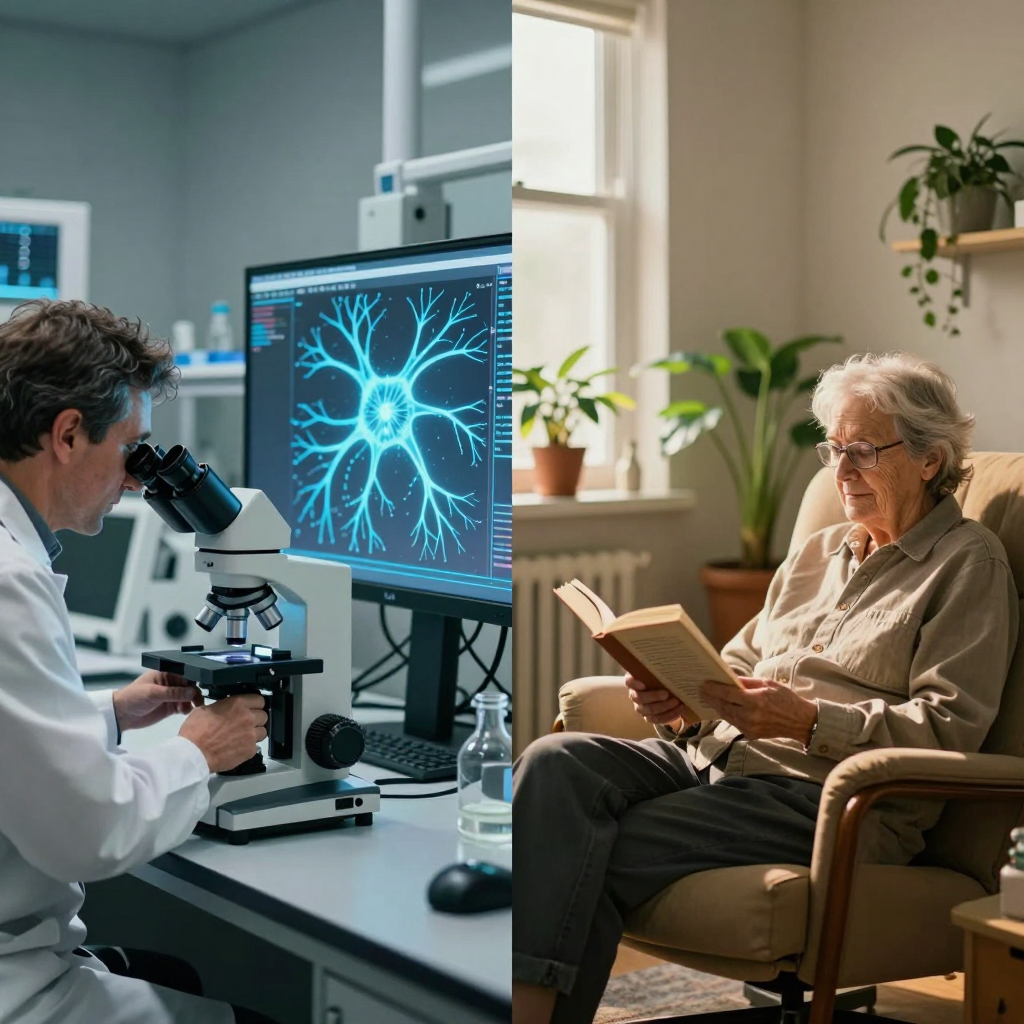
Compara estas dos imágenes. En tu respuesta, debes describir las diferencias entre los dos entornos, comparar las distintas formas de investigación o estudio que se muestran y especular sobre cómo cada escena podría estar relacionada con el funcionamiento del cerebro humano. Debes hablar durante 2 minutos.
🖼️ 
Useful phrases
- At first glance, it appears that... — A primera vista, parece que... 🔊
- While the former depicts..., the latter shows... — Mientras que la primera imagen representa..., la segunda muestra... 🔊
- There is a striking contrast between... — Hay un contraste llamativo entre... 🔊
- One could surmise that... — Se podría suponer que... 🔊
- It is highly probable that... — Es muy probable que... 🔊
- In stark contrast to the clinical setting... — En marcado contraste con el entorno clínico... 🔊
- This might be indicative of... — Esto podría ser indicativo de... 🔊
- They both seem to revolve around... — Ambas parecen girar en torno a... 🔊
- It's plausible to assume that... — Es plausible suponer que... 🔊
- The two scenes are diametrically opposed in terms of... — Las dos escenas son diametralmente opuestas en cuanto a... 🔊
- Judging by the visual cues... — A juzgar por las pistas visuales... 🔊
- One might infer that... — Uno podría inferir que... 🔊
Pronunciación
Para sonar más natural en el examen, practica el 'Linking and Catenation'. Esto ocurre cuando el sonido final de una palabra se une al sonido inicial de la siguiente (por ejemplo, 'it appears' suena como /ɪtəˈpɪəz/). En el C1, esto ayuda a evitar un habla entrecortada y mejora la fluidez necesaria para comparar conceptos complejos.
Model answer
🔊
Both images explore the concept of cognitive engagement, albeit through vastly different lenses. In the first image, we see a highly clinical, technologically advanced laboratory where a scientist is examining a digital representation of a neural network. This scene suggests a microscopic, data-driven approach to understanding the brain. In stark contrast, the second image depicts a much more organic and tranquil scene: an elderly individual engaged in the quiet act of reading. While the former focuses on the biological hardware of the brain, the latter illustrates the cognitive software in action.
One could surmise that these two scenes represent the two sides of neuroscience. The laboratory setting might be investigating the physical structures of thought, whereas the domestic scene shows the practical application of those neural pathways through lifelong learning. It is highly probable that the research being conducted in the first image aims to better understand the cognitive processes seen in the second. Ultimately, while the first image is sterile and analytical, the second is warm and human, yet both are fundamentally linked to the study of the human mind and how we process information throughout our lives.