
Speaking Lab
Image-based speaking practice with useful phrases, pronunciation focus and model response.
Lesson objectives
- Describe, compare and speculate more naturally under speaking-task pressure.
- Use useful phrases with better rhythm, stress and connected speech.
- Respond to image prompts connected to space exploration & astronomy with C1-level range.
Listen to the model audio before you answer the lesson tasks.
Speaking — describe & compare
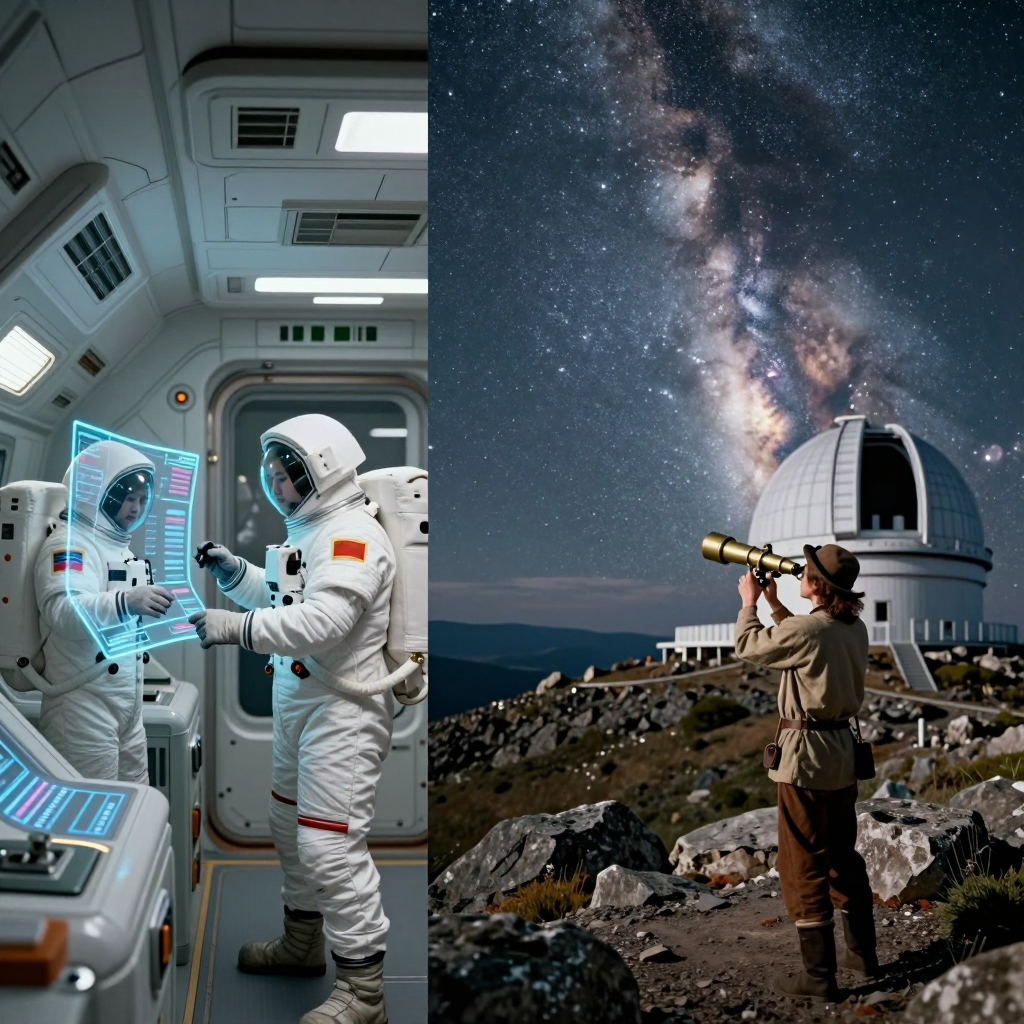
Compara estas dos imágenes. En tu respuesta, debes describir las diferencias entre las dos formas de exploración espacial y expresar lo que crees que está ocurriendo en cada escena. Debes hablar durante 2 minutos.
🖼️ 
Useful phrases
- At first glance, it appears that... — A primera vista, parece que... 🔊
- In stark contrast to the first image... — En marcado contraste con la primera imagen... 🔊
- One could argue that the technology... — Se podría argumentar que la tecnología... 🔊
- There is a palpable sense of... — Hay una sensación palpable de... 🔊
- While the former depicts..., the latter shows... — Mientras que la primera representa..., la segunda muestra... 🔊
- It is highly likely that... — Es muy probable que... 🔊
- They both seem to revolve around... — Ambas parecen girar en torno a... 🔊
- The juxtaposition of these two scenes... — La yuxtaposición de estas dos escenas... 🔊
- It might be inferred that... — Se podría inferir que... 🔊
- Strikingly different from one another, they... — Muy diferentes entre sí, ellos... 🔊
- The atmosphere in the first picture is... — La atmósfera en la primera imagen es... 🔊
- Both images touch upon the theme of... — Ambas imágenes tocan el tema de... 🔊
Pronunciación
En el examen C1, la entonación es clave para la especulación. En el inglés británico (RP), solemos usar una entonación más descendente al final de una afirmación para sonar seguros, pero una entonación ascendente cuando estamos 'hedging' (suavizando una opinión o especulando). Practica la diferencia entre la pronunciación de 'research' (énfasis en la segunda sílaba en UK) y asegúrate de no sobre-pronunciar la 'r' final en palabras como 'star' o 'space' para mantener un acento británico natural.
Model answer
🔊
Both images capture the human fascination with the cosmos, yet they represent vastly different eras of discovery. At first glance, the left-hand image depicts a highly advanced, almost clinical environment within a space station. The astronauts seem entirely absorbed in their technological tasks, suggesting that space exploration has become a routine, albeit complex, professional endeavour. In stark contrast, the right-hand image shows a much more romanticised and solitary pursuit. We see an individual using a traditional brass telescope, which evokes a sense of wonder and the raw, pioneering spirit of early astronomy.
While the former focuses on the practicalities of living in space through cutting-edge technology, the latter highlights the fundamental human desire to observe and understand the heavens. One could argue that while the technology in the first image is more efficient, the second image captures the emotional essence of discovery more effectively. It might be inferred that despite the leap from manual telescopes to holographic interfaces, the core motivation remains unchanged: our innate curiosity about the universe. Ultimately, both scenes illustrate the evolution of how we bridge the gap between Earth and the stars.