
Speaking Lab
Image-based speaking practice with useful phrases, pronunciation focus and model response.
Lesson objectives
- Describe, compare and speculate more naturally under speaking-task pressure.
- Use useful phrases with better rhythm, stress and connected speech.
- Respond to image prompts connected to education & knowledge with C1-level range.
Listen to the model audio before you answer the lesson tasks.
Speaking — describe & compare
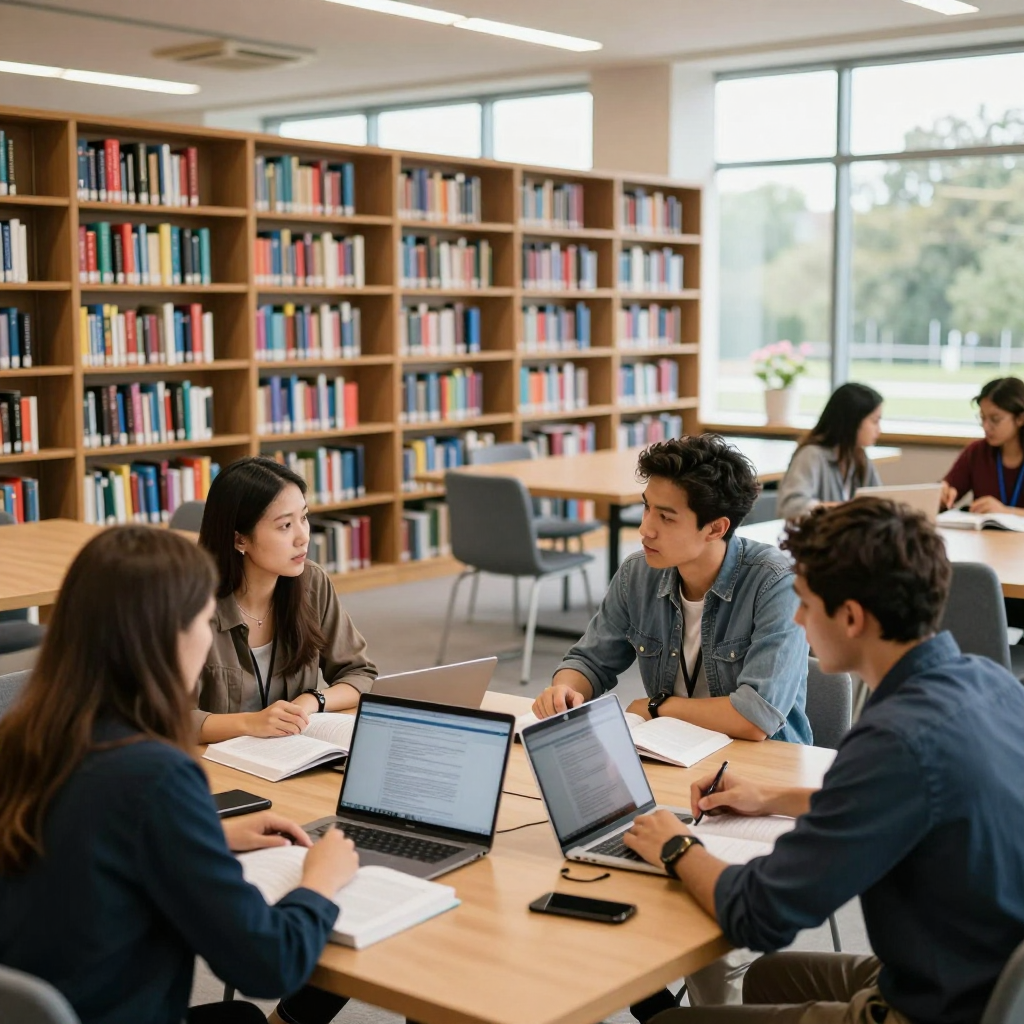
Compara las dos imágenes (la de la biblioteca y una imaginaria de un aula tradicional) y responde a la pregunta: ¿Qué ventajas ofrece el aprendizaje colaborativo frente al estudio individual?
🖼️ 
Useful phrases
- It appears to me that... — Me parece que... 🔊
- One could argue that... — Se podría argumentar que... 🔊
- In stark contrast to... — En marcado contraste con... 🔊
- There is a noticeable difference between... — Hay una diferencia notable entre... 🔊
- They seem to be engrossed in... — Parecen estar absortos en... 🔊
- It is highly likely that... — Es muy probable que... 🔊
- While the first image depicts..., the second shows... — Mientras que la primera imagen representa..., la segunda muestra... 🔊
- This suggests that... — Esto sugiere que... 🔊
- On the other hand, one might consider... — Por otro lado, uno podría considerar... 🔊
- It is somewhat evident that... — Es algo evidente que... 🔊
- Both scenarios illustrate... — Ambos escenarios ilustran... 🔊
- The atmosphere seems to be... — El ambiente parece ser... 🔊
Pronunciación
Presta atención a la derivación polisilábica y al cambio de acentuación. En inglés, al pasar de un sustantivo de dos sílabas a uno de tres o más, el acento tónico suele desplazarse. Por ejemplo: 'PHO-to-graph' (acento en la primera sílaba) frente a 'pho-TOG-ra-phy' (acento en la segunda sílaba). Practica este movimiento rítmico para sonar más natural.
Model answer
🔊
In this image, I can see a group of students engaged in what looks like a collaborative study session within a contemporary library setting. They seem to be deeply engrossed in their discussion, sharing ideas and resources, which suggests a highly interactive approach to learning. It appears to me that they are working towards a common goal, perhaps preparing for a complex project or exam.
In stark contrast to a traditional, silent classroom where students work in isolation, this scene depicts a more dynamic and social form of education. While one could argue that individual study is essential for deep concentration, the advantages of this collaborative environment are quite evident. It allows for the immediate exchange of knowledge and the development of critical thinking through debate.
If we were to compare this to a more formal lecture-based setting, the atmosphere here feels much more student-centred and engaging. It is highly likely that such interaction fosters better retention of information, as students must articulate their thoughts to others. Ultimately, this scene perfectly illustrates the modern shift towards peer-to-peer learning and the importance of social interaction in the pursuit of knowledge.