
Speaking Lab
Image-based speaking practice with useful phrases, pronunciation focus and model response.
Lesson objectives
- Describe, compare and speculate more naturally under speaking-task pressure.
- Use useful phrases with better rhythm, stress and connected speech.
- Respond to image prompts connected to science & discovery with C1-level range.
Listen to the model audio before you answer the lesson tasks.
Speaking — describe & compare
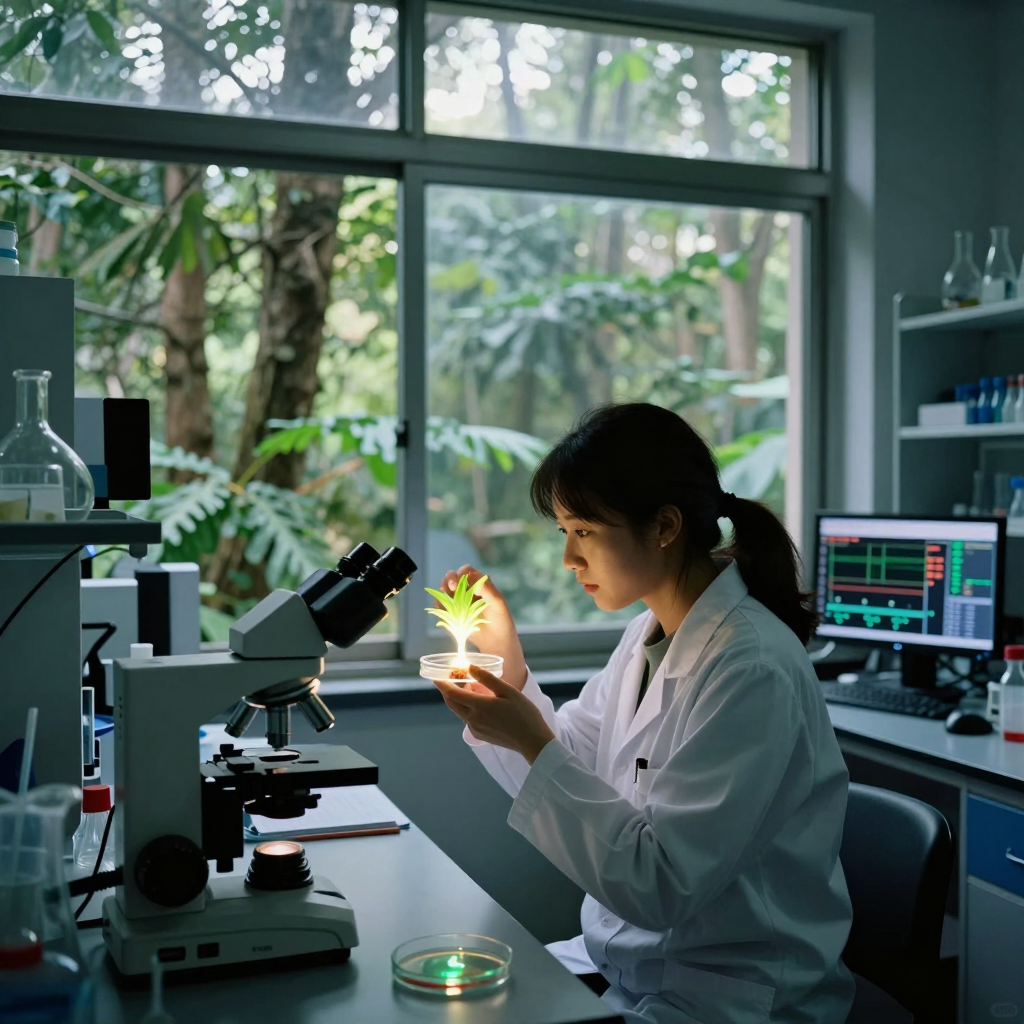
Compara las dos imágenes (la escena de laboratorio y la naturaleza) y responde a la pregunta: ¿Cómo pueden los avances científicos ayudar a proteger el mundo natural?
🖼️ 
Useful phrases
- It appears as though the scientist is... — Parece como si la científica estuviera... 🔊
- One could surmise that the research focuses on... — Se podría suponer que la investigación se centra en... 🔊
- In stark contrast to the clinical setting... — En marcado contraste con el entorno clínico... 🔊
- There is a striking resemblance between... — Hay un parecido sorprendente entre... 🔊
- The juxtaposition of technology and nature suggests... — La yuxtaposición de la tecnología y la naturaleza sugiere... 🔊
- It is highly probable that the specimen is... — Es muy probable que el espécimen sea... 🔊
- While the laboratory is sterile, the forest is... — Mientras que el laboratorio es estéril, el bosque es... 🔊
- Judging by her expression, she seems to... — A juzgar por su expresión, parece que ella... 🔊
- The scene conveys a sense of... — La escena transmite una sensación de... 🔊
- One might argue that science and nature are... — Se podría argumentar que la ciencia y la naturaleza son... 🔊
- The visual elements imply that... — Los elementos visuales implican que... 🔊
- On the one hand... whereas on the other hand... — Por un lado... mientras que por otro lado... 🔊
Pronunciación
Para sonar más natural en el examen, presta atención al sonido 'schwa' /ə/. Este es el sonido más común en inglés y ocurre en sílabas no acentuadas de palabras funcionales (como 'a', 'the', 'of' o el final de 'scientist'). En lugar de pronunciar cada vocal con claridad, relaja la lengua y produce un sonido neutro y breve. Por ejemplo, en 'a scientist', la 'a' no es /eɪ/, sino /ə/.
Model answer
🔊
In this image, we see a scientist working in a cutting-edge laboratory, which is juxtaposed with a lush, green forest visible through a large window. The atmosphere is a blend of clinical precision and organic beauty. It appears as though the researcher is studying a bioluminescent plant, perhaps attempting to understand how to replicate its natural properties through biotechnology. The contrast between the sterile, high-tech environment and the wild, untamed greenery outside is quite striking.
Regarding the question of how science can protect the natural world, one could surmise that this scene illustrates a harmonious relationship rather than a conflict. While some might argue that technological advancement often leads to environmental degradation, it is highly probable that modern science is our best tool for conservation. For instance, through genetic research or ecological monitoring, scientists can develop ways to preserve endangered species or combat climate change. Judging by the setting, it seems to suggest that scientific discovery is not an alternative to nature, but rather a means to understand and safeguard it. Ultimately, the integration of technology and biology could be the key to maintaining the delicate balance of our planet's ecosystems.