
Speaking Lab
Image-based speaking practice with useful phrases, pronunciation focus and model response.
Lesson objectives
- Describe, compare and speculate more naturally under speaking-task pressure.
- Use useful phrases with better rhythm, stress and connected speech.
- Respond to image prompts connected to art, literature & creativity with C1-level range.
Listen to the model audio before you answer the lesson tasks.
Speaking — describe & compare
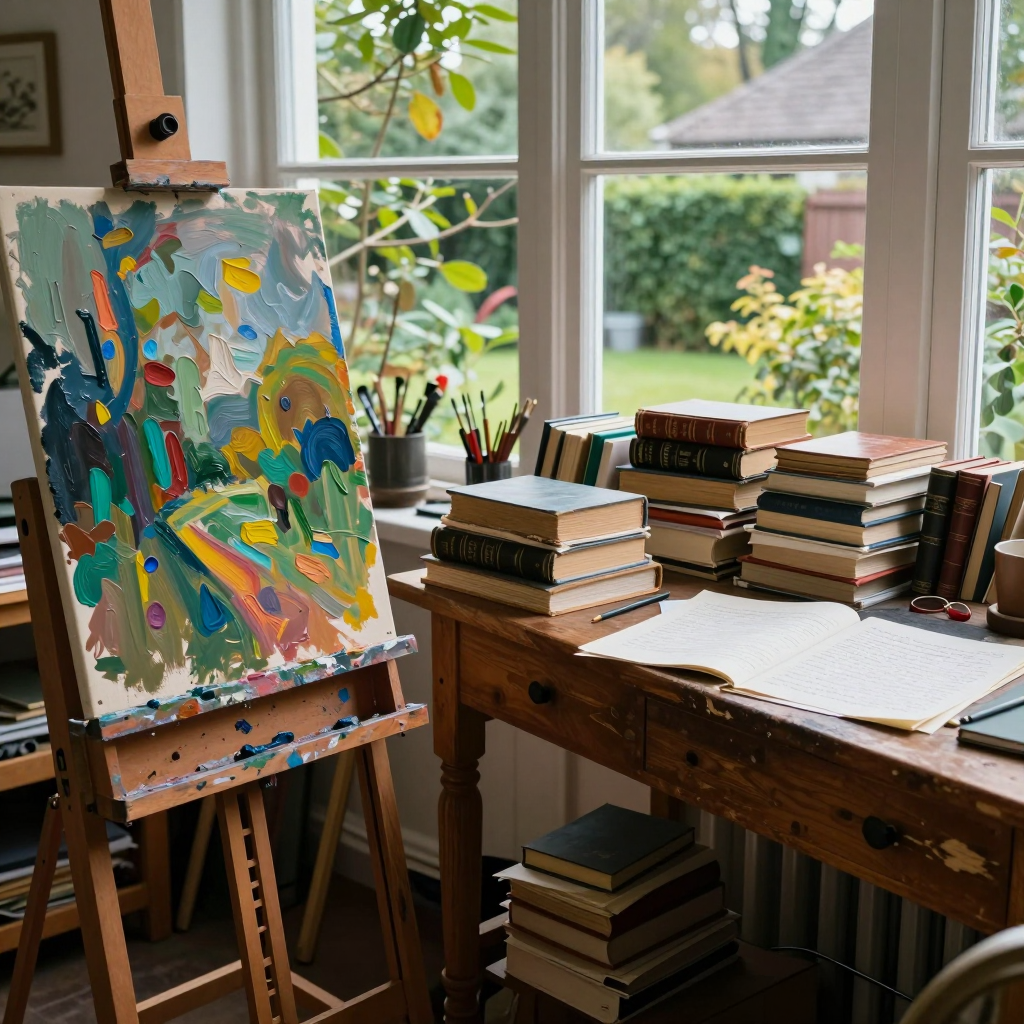
Compara las dos imágenes (el proceso creativo frente al estudio de la literatura) y responde a la pregunta: ¿Qué aspectos de estas actividades crees que resultan más estimulantes para la mente?
🖼️ 
Useful phrases
- It appears to me that... — Me parece que... 🔊
- One could argue that... — Se podría argumentar que... 🔊
- In stark contrast to the first scene... — En marcado contraste con la primera escena... 🔊
- While the former depicts..., the latter suggests... — Mientras que lo primero representa..., lo segundo sugiere... 🔊
- There is a sense of... — Hay una sensación de... 🔊
- It is highly likely that... — Es muy probable que... 🔊
- They both share a common theme of... — Ambos comparten un tema común de... 🔊
- One might surmise that... — Uno podría conjeturar que... 🔊
- The atmosphere is somewhat... — El ambiente es algo... 🔊
- Judging by the visual cues... — A juzgar por las pistas visuales... 🔊
- It's hard to tell for certain, but... — Es difícil saberlo con certeza, pero... 🔊
- The two scenes are fundamentally different yet... — Las dos escenas son fundamentalmente diferentes pero... 🔊
Pronunciación
Para alcanzar el nivel C1, evita la entonación plana. En las oraciones declarativas, utiliza una caída de tono al final para sonar seguro. En las preguntas de especulación, utiliza una entonación ascendente para mostrar curiosidad o duda, lo cual ayuda a enfatizar el matiz de la hipótesis.
Model answer
🔊
In both images, we are looking at different facets of the creative process. The first scene depicts a vibrant artist's studio, where the focus is clearly on visual expression through thick, colourful oil paints. In stark contrast, the second part of the scene shows a desk overflowing with literature, suggesting a more cerebral and quiet form of creativity. While the former is visually explosive, the latter seems to represent a more introspective and structured kind of work.
Regarding the question of what is more stimulating, I would argue that both offer unique mental challenges. The artist's environment suggests a sensory-driven stimulation, where one might surmise that the tactile nature of painting provides an immediate emotional release. On the other hand, the literary setting implies a deep, intellectual engagement that requires intense concentration and solitude. Ultimately, I believe the most stimulating aspect is the ability to translate abstract thoughts into something tangible, whether that be through a brushstroke or a written sentence. Both environments facilitate this escape from reality, providing a sense of purpose that is essential for mental well-being.