
Speaking Lab
Image-based speaking practice with useful phrases, pronunciation focus and model response.
Lesson objectives
- Describe, compare and speculate more naturally under speaking-task pressure.
- Use useful phrases with better rhythm, stress and connected speech.
- Respond to image prompts connected to quantum physics & future technology with C1-level range.
Listen to the model audio before you answer the lesson tasks.
Speaking — describe & compare
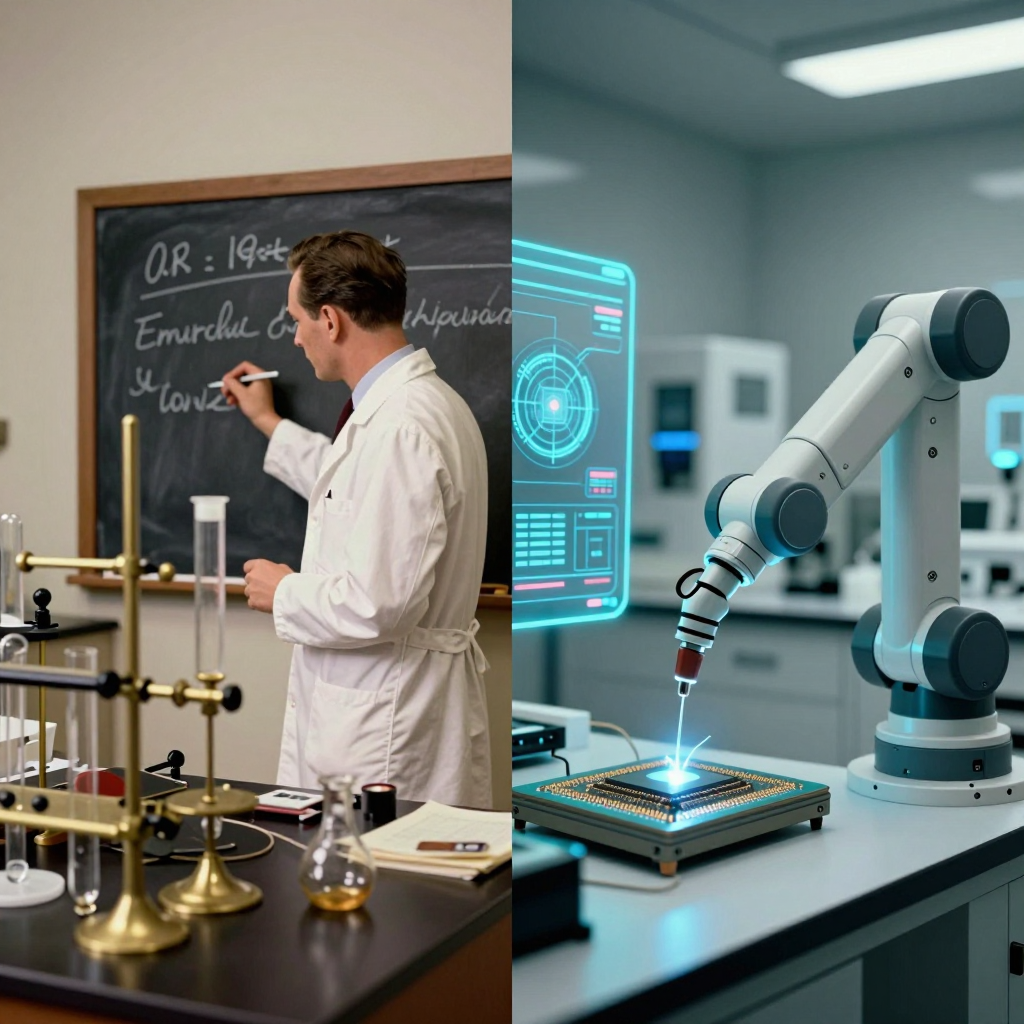
Compara estas dos imágenes. En ambas, vemos el avance de la tecnología científica. Describe las diferencias en cuanto a la atmósfera y los métodos utilizados, y explica si crees que el progreso tecnológico nos hace la vida más sencilla o más compleja. Habla durante 2 minutos.
🖼️ 
Useful phrases
- At first glance, it appears that... — A primera vista, parece que... 🔊
- The two images stand in stark contrast to one another. — Las dos imágenes contrastan fuertemente entre sí. 🔊
- While the former depicts a traditional setting, the latter... — Mientras que la primera representa un entorno tradicional, la segunda... 🔊
- It is highly probable that the researcher is... — Es muy probable que el investigador esté... 🔊
- One could argue that the shift towards automation... — Se podría argumentar que el cambio hacia la automatización... 🔊
- There is a sense of nostalgia in the first picture, whereas... — Hay un sentimiento de nostalgia en la primera imagen, mientras que... 🔊
- The technological leap is quite evident when comparing... — El salto tecnológico es bastante evidente al comparar... 🔊
- It might be inferred that the tools have become... — Se podría inferir que las herramientas se han vuelto... 🔊
- In much the same way as, the second image suggests... — De la misma manera que, la segunda imagen sugiere... 🔊
- The atmosphere in the left-hand image is somewhat... — La atmósfera en la imagen de la izquierda es algo... 🔊
- It is hard to tell exactly how much... — Es difícil determinar exactamente cuánto... 🔊
- Taking everything into account, it seems that... — Teniendo todo en cuenta, parece que... 🔊
Pronunciación
Para sonar más natural en el C1, presta atención al sonido 'schwa' /ə/. Este es el sonido más común en inglés y ocurre en sílabas no acentuadas. Por ejemplo, en la palabra 'technology' /tekˈnɒlədʒi/, la segunda sílaba es un schwa. Evita pronunciar cada vocal con claridad; en su lugar, relaja la lengua para producir este sonido neutro y suave. Esto ayudará a que tu ritmo sea más fluido y menos robótico.
Model answer
🔊
At first glance, these two images present a striking contrast between the historical foundations of science and the cutting-edge reality of modern quantum technology. The left-hand side depicts a traditional, mid-century laboratory, characterized by tactile, analog equipment and a sense of manual discovery. In stark contrast, the right-hand image showcases a futuristic, high-tech environment where holographic interfaces and robotics suggest a much more automated and precise era of research.
While the former captures a period of human-centric experimentation, the latter implies a shift towards digital sophistication. One could argue that while the tools have become significantly more advanced, the core objective remains the same: pushing the boundaries of human knowledge. Regarding the impact on our lives, it might be inferred that although these advancements offer incredible efficiency, they also introduce a level of complexity that could be overwhelming. Ultimately, the transition from the chalkboard to the hologram represents a massive technological leap, moving from the era of classical physics into the unpredictable realm of quantum mechanics. It is fascinating to consider how much the atmosphere of discovery has changed from that warm, amber-lit room to this sterile, blue-toned future.