
Speaking Lab
Image-based speaking practice with useful phrases, pronunciation focus and model response.
Lesson objectives
- Describe, compare and speculate more naturally under speaking-task pressure.
- Use useful phrases with better rhythm, stress and connected speech.
- Respond to image prompts connected to blockchain, crypto & decentralised finance with C1-level range.
Listen to the model audio before you answer the lesson tasks.
Speaking — describe & compare
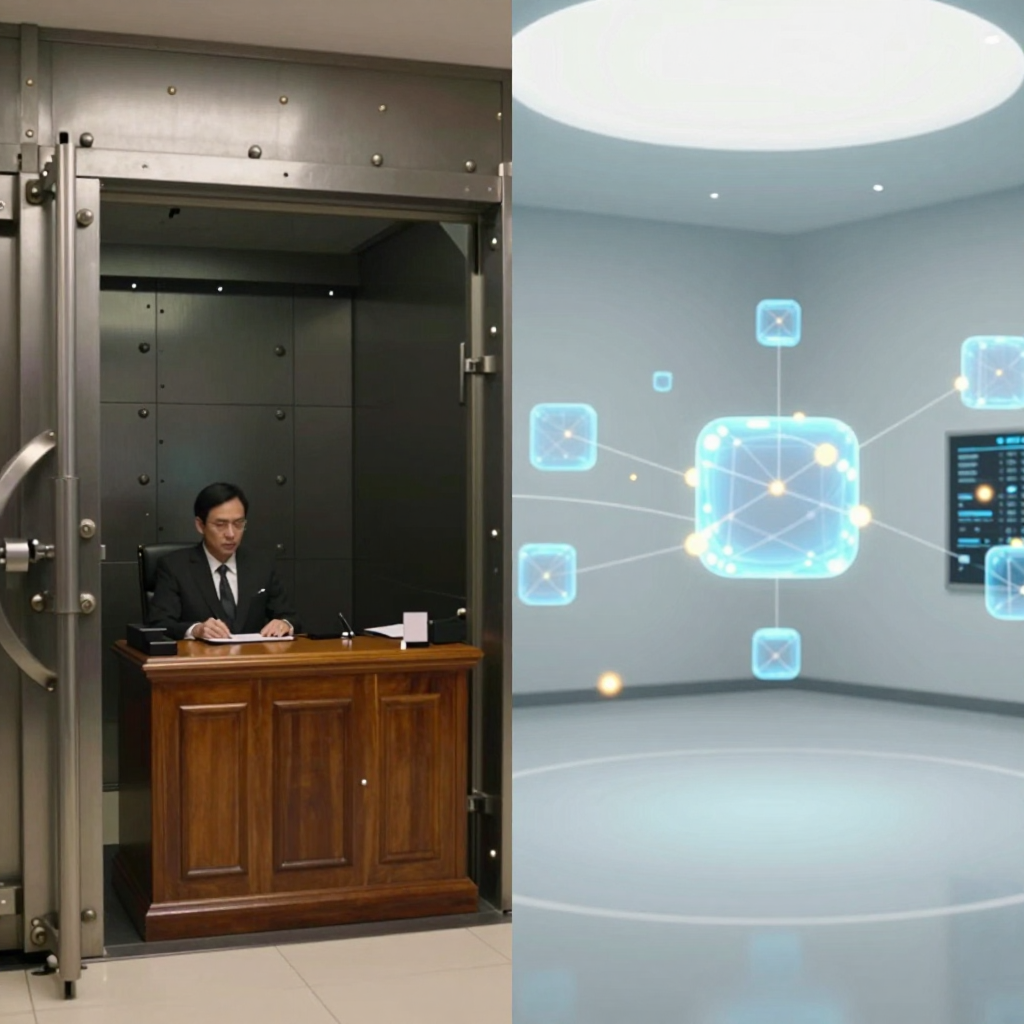
Compara estas dos imágenes. En tu respuesta, debes describir las diferencias entre los dos entornos y especular sobre cómo representan distintas formas de gestionar el dinero o la seguridad. Debes hablar durante 2 minutos.
🖼️ 
Useful phrases
- While the first image depicts a traditional setting, the second one conveys... — Mientras que la primera imagen representa un entorno tradicional, la segunda transmite... 🔊
- In stark contrast to the physical constraints of the vault, the digital network... — En marcado contraste con las limitaciones físicas de la bóveda, la red digital... 🔊
- One could argue that the left image symbolises stability, whereas... — Se podría argumentar que la imagen de la izquierda simboliza estabilidad, mientras que... 🔊
- The visual juxtaposition of these two scenes suggests... — La yuxtaposición visual de estas dos escenas sugiere... 🔊
- It is highly likely that the digital elements represent decentralisation. — Es muy probable que los elementos digitales representen la descentralización. 🔊
- The shift from tangible assets to digital ledgers is evident here. — El cambio de activos tangibles a libros de contabilidad digitales es evidente aquí. 🔊
- There seems to be a clear dichotomy between physical and virtual... — Parece haber una clara dicotomía entre lo físico y lo virtual... 🔊
- Judging by the lighting, the digital side aims to evoke a sense of... — A juzgar por la iluminación, el lado digital pretende evocar una sensación de... 🔊
- The traditional scene is characterised by its heavy, tactile nature. — La escena tradicional se caracteriza por su naturaleza pesada y táctil. 🔊
- Conversely, the right-hand side offers a more fluid and abstract... — Por el contrario, el lado derecho ofrece una visión más fluida y abstracta... 🔊
- It might be inferred that the transition represents a paradigm shift. — Se podría inferir que la transición representa un cambio de paradigma. 🔊
- Both images touch upon the concept of security, albeit in different ways. — Ambas imágenes abordan el concepto de seguridad, aunque de diferentes maneras. 🔊
Pronunciación
Cuidado con el acento tónico en palabras compuestas frente a frases sustantivas. En inglés, cuando un sustantivo actúa como adjetivo (ej. 'blockchain technology'), el énfasis suele recaer en la primera palabra ('BLOCKchain technology'). Sin embargo, en una frase nominal estándar ('the technology is BLOCKchain'), el énfasis puede cambiar. Practica la diferencia entre 'BANK vault' (énfasis en BANK) y 'a vault in a bank'.
Model answer
🔊
Both images present a striking contrast between traditional and modern financial systems. On the left, we see a conventional bank vault, characterised by heavy iron doors and a dimly lit, somewhat claustrophobic atmosphere. This scene evokes a sense of physical security and tangible assets, where transactions are handled by a single person in a controlled, brick-and-mortar environment. It represents the old guard of finance—centralised and strictly physical.
In stark contrast, the right-hand side depicts a futuristic, digital landscape. Instead of heavy doors, we see a glowing, interconnected network of light and cubes, which I would interpret as a visual metaphor for blockchain technology and decentralised finance. There is no single person in charge here; instead, the focus is on the seamless, fluid flow of data. While the left image suggests stability through physical weight, the right one conveys security through transparency and complex algorithms. Ultimately, the juxtaposition suggests a paradigm shift: moving from the heavy, centralised structures of the past towards a more intangible, distributed, and digitalised future where trust is built through code rather than iron locks.