
Speaking Lab
Image-based speaking practice with useful phrases, pronunciation focus and model response.
Lesson objectives
- Describe, compare and speculate more naturally under speaking-task pressure.
- Use useful phrases with better rhythm, stress and connected speech.
- Respond to image prompts connected to biodiversity, ecosystems & extinction with C1-level range.
Listen to the model audio before you answer the lesson tasks.
Speaking — describe & compare
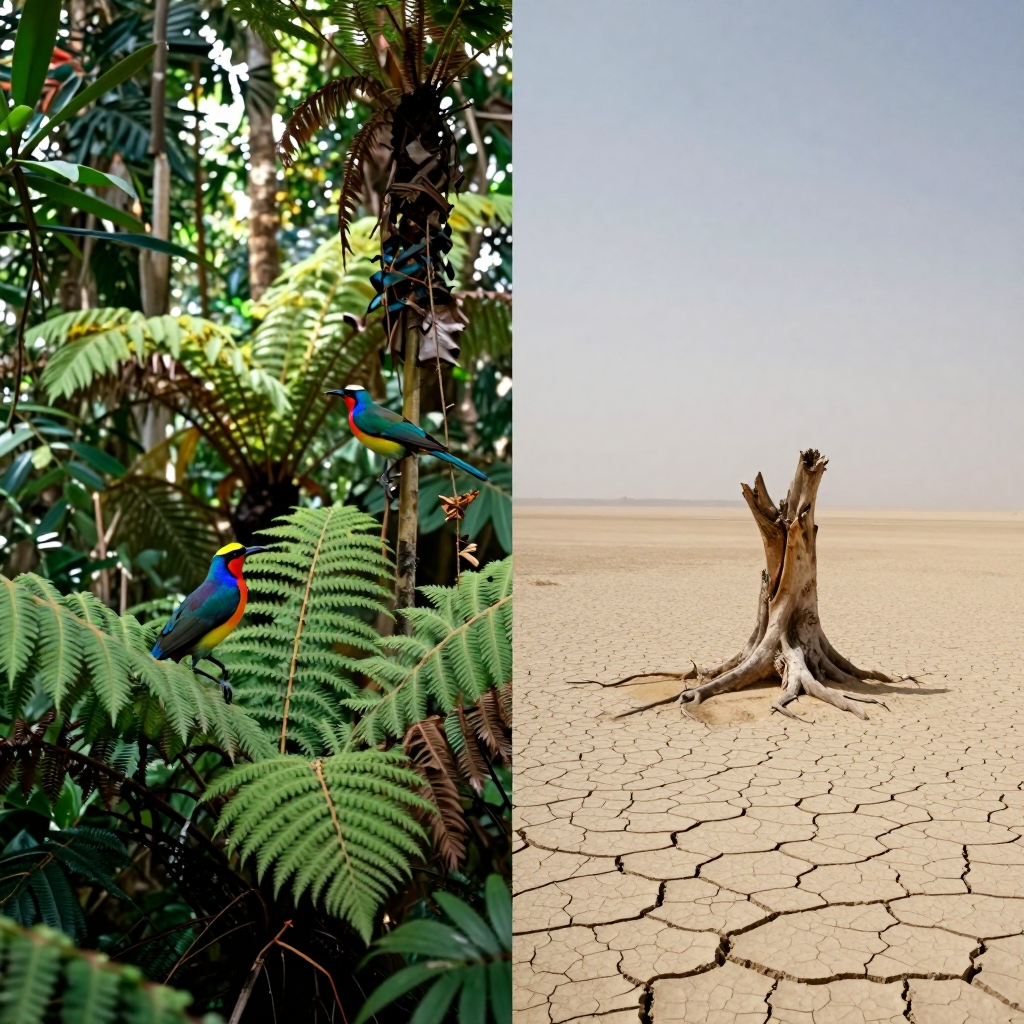
Compara estas dos imágenes. En ambas fotos, se muestran entornos naturales muy diferentes. Describe las diferencias entre los dos paisajes y responde a las preguntas: ¿Qué impacto tiene el cambio climático en estos ecosistemas? y ¿Cómo afecta la pérdida de biodiversidad a la vida humana?
🖼️ 
Useful phrases
- In the first image, we can see... — En la primera imagen, podemos ver... 🔊
- In stark contrast to the first photo... — En marcado contraste con la primera foto... 🔊
- The two scenes depict vastly different... — Las dos escenas representan... muy diferentes 🔊
- It is highly likely that... — Es muy probable que... 🔊
- One could argue that... — Se podría argumentar que... 🔊
- The visual juxtaposition suggests... — La yuxtaposición visual sugiere... 🔊
- While the left side is teeming with life... — Mientras que el lado izquierdo rebosa de vida... 🔊
- The right side appears to be utterly barren... — El lado derecho parece estar completamente estéril... 🔊
- This could be interpreted as... — Esto podría interpretarse como... 🔊
- There is a striking difference between... — Hay una diferencia impactante entre... 🔊
- It seems to imply a sense of... — Parece implicar una sensación de... 🔊
- Both images touch upon the theme of... — Ambas imágenes tocan el tema de... 🔊
Pronunciación
En el inglés británico, la 'r' al final de una palabra (como en 'nature' o 'clear') suele ser muda. Sin embargo, utilizamos la 'intrusive /r/' cuando una palabra que termina en vocal se une a una palabra que empieza con vocal para facilitar la fluidez. Por ejemplo, en 'nature is' suena como /neɪtʃərɪz/. Practica la unión de sonidos para evitar pausas bruscas entre palabras.
Model answer
🔊
The two images present a striking juxtaposition of two vastly different environmental states. On the left, we see a lush, vibrant rainforest, seemingly teeming with life and biodiversity. The dense canopy and rich greenery suggest a healthy, thriving ecosystem where various species can coexist. In stark contrast, the right side depicts a desolate, arid landscape. The cracked earth and the solitary, withered tree stump convey a sense of extinction and ecological collapse.
It is highly likely that these images are intended to illustrate the devastating impact of climate change. While the first scene represents a balanced ecosystem, the second could be the result of desertification or extreme drought. One could argue that the transition from the left to the right represents the precarious state of our planet. If we continue to ignore the loss of biodiversity, these barren landscapes could become our new reality. The visual contrast serves as a powerful reminder of how fragile these ecosystems are. Ultimately, the images prompt us to consider whether we can protect the vitality of the first scene or if we are inevitably drifting towards the desolation shown on the right.